Date China takes major military action against Taiwan – 2034
(a) at least 1,000 People's Liberation Army military personnel have been deployed to the main island of Taiwan for the purpose of establishing PRC sovereignty;
(b) the People's Republic of China has imposed a blockade that closes all major Taiwanese ports (Kaohsiung, Keelung, Taichung, and Taipei) for at least 10 consecutive days; or
(c) the People's Republic of China has launched kinetic strikes (missiles, airstrikes, or naval bombardment) against military or civilian infrastructure on the main island of Taiwan.
Exclusions: military exercises that do not actively intercept traffic or strike targets; cyber-only operations; actions limited to outlying islands (Kinmen, Matsu, Penghu) without action against the main island; economic sanctions or trade restrictions without physical military action.
Bars include events up to their close, 23:59:59 UTC: “By end of Apr 2026” includes everything up to 30 Apr 2026, 23:59:59 UTC.
Reference classes
We use three levels of evidence, from general to specific, combined with partial pooling to estimate a time-varying monthly hazard rate.
Level 1: General territorial dispute base rate
Among all major-power territorial disputes post-1945, roughly 1-2% per year escalate to significant military action. This comes from the Correlates of War MID dataset (~2,400 militarized interstate disputes 1816-2014, 85% of fatal conflicts involving territorial issues). This is the weakest prior — just a sanity floor.
Level 2: Major powers with active military buildup for a specific territorial goal
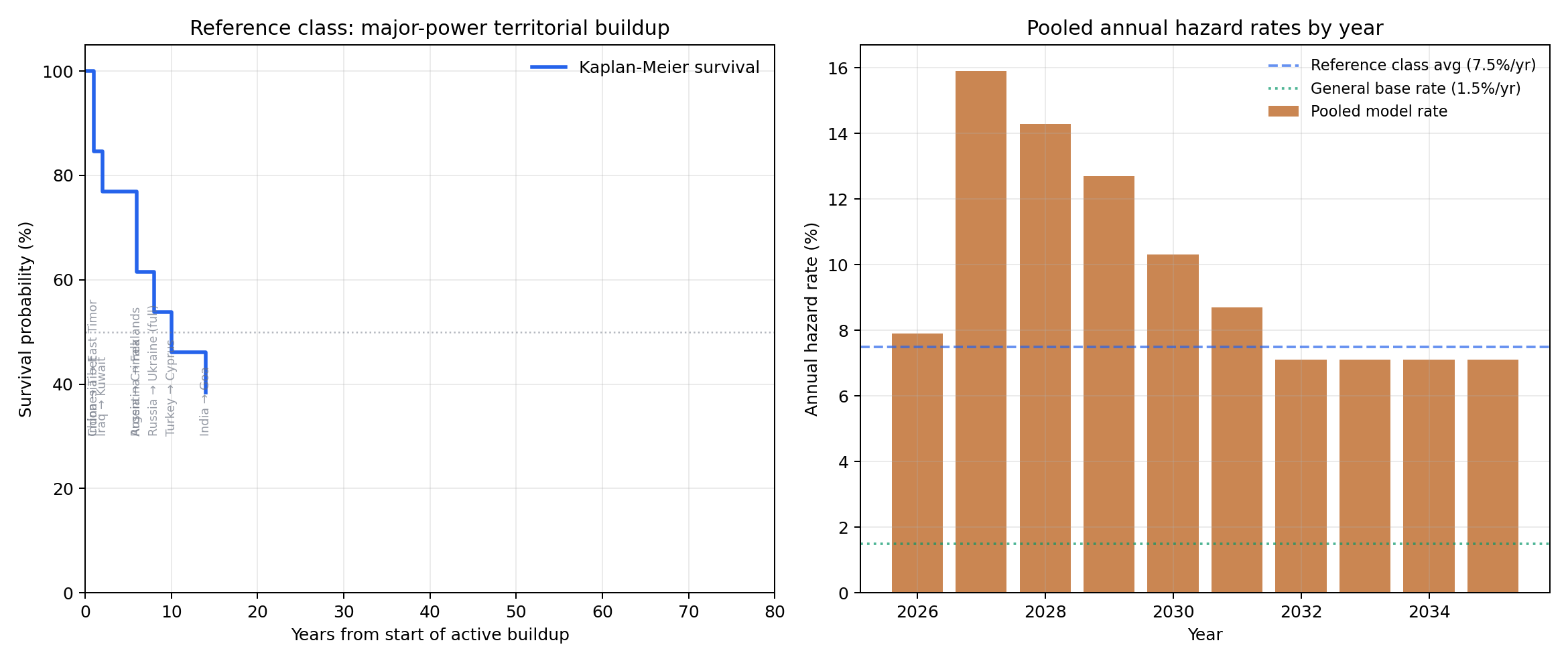
This is the core reference class. We identified 13 historical cases — 8 that resulted in military action, 5 where no action has been taken despite decades of tension.
Cases that resulted in military action:
| Case | Buildup start | Action year | Time to action |
|---|---|---|---|
| China → Tibet | 1949 | 1950 | 1 years |
| Indonesia → East Timor | 1974 | 1975 | 1 years |
| Iraq → Kuwait | 1988 | 1990 | 2 years |
| Argentina → Falklands | 1976 | 1982 | 6 years |
| Russia → Crimea | 2008 | 2014 | 6 years |
| Turkey → Cyprus | 1964 | 1974 | 10 years |
| India → Goa | 1947 | 1961 | 14 years |
| Russia → Ukraine (full) | 2014 | 2022 | 8 years |
Cases where no military action has been taken:
| Case | Buildup start | Duration so far |
|---|---|---|
| China → Taiwan | 1949 | 77+ years (ongoing) |
| India → Pak Kashmir | 1947 | 79+ years (ongoing) |
| Greece → Turkey Aegean | 1974 | 52+ years (ongoing) |
| N. Korea → S. Korea | 1953 | 73+ years (ongoing) |
| Venezuela → Essequibo | 1966 | 60+ years (ongoing) |
Kaplan-Meier survival analysis of these 13 cases gives roughly 54% probability of action within 10 years of active buildup starting, implying an average annual hazard of ~7.5%/year during the buildup phase. The median time to action among those that acted was ~6 years.
The cases where no action was taken are critical — they show that roughly 40% of these disputes simply never result in full military action, even over many decades. China-Taiwan itself is the longest-running such case at 77 years.
Level 3: China-Taiwan specific expert data
Current prediction markets and expert surveys (as of March 2026) provide the most directly relevant evidence:
- Metaculus: full-scale blockade by 2030 at 40%, by 2035 at 60%; full-scale invasion by 2028 at 10%, by 2030 at ~20%, by 2035 at ~33%
- CSIS 2024 survey: 52% of 64 China experts think force short of invasion “likely” within 10 years; only 27% of US experts and 17% of Taiwan experts believe China can currently execute an amphibious invasion
- Swift Centre: 9% blockade probability by mid-2027
- Pentagon 2025 report: PLA targeting capability to fight and win a Taiwan war by end of 2027; new bridge landing vessels and expanded amphibious training observed
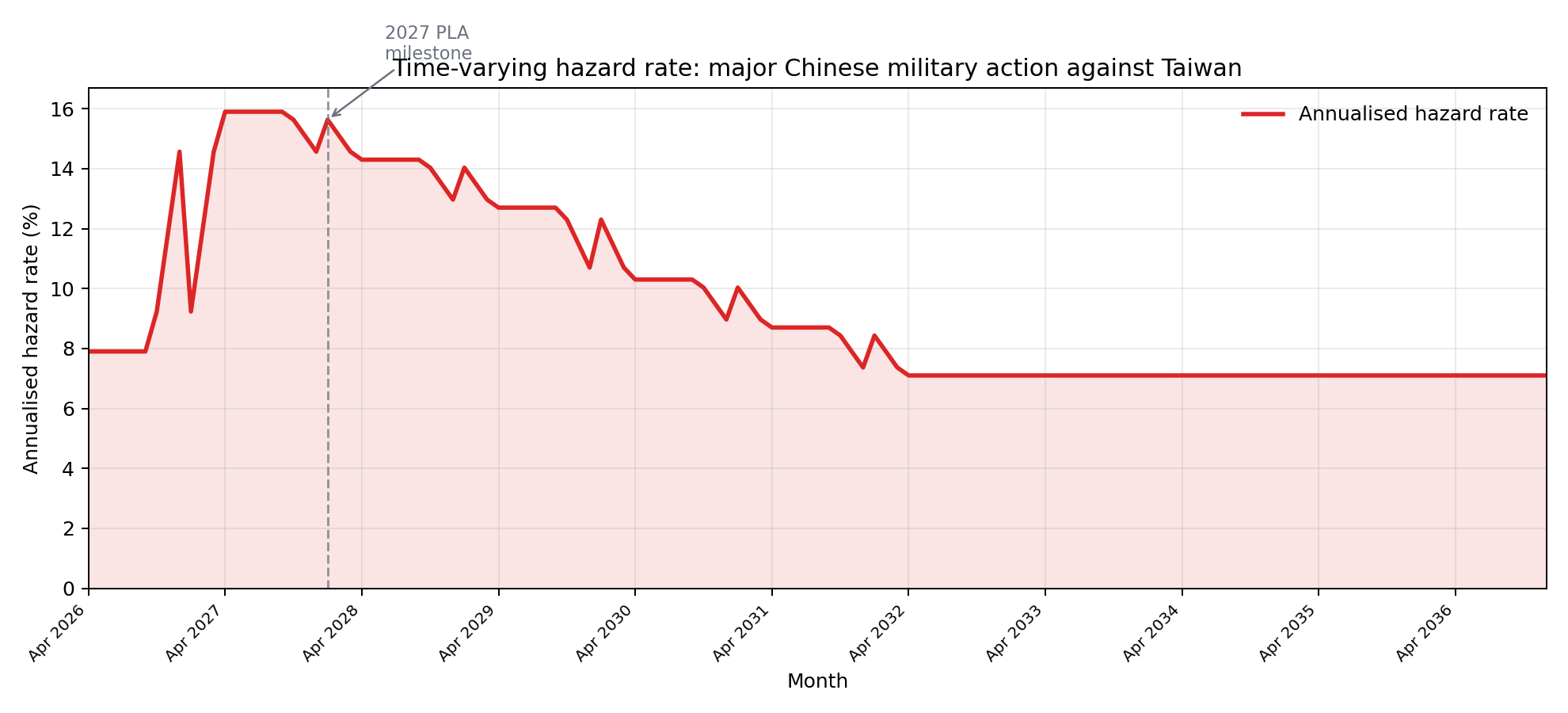
These imply annualised hazard rates of ~12-16%/year near-term (peaking 2027-2028 around the PLA modernisation milestone), declining to ~7%/year long-term.
Multilevel model
The posterior annual hazard rate for each year is a weighted average of Level 2 and Level 3:
λ_pooled(year) = 0.80 × λ_specific(year) + 0.20 × λ_group
- 80% weight on Level 3 (specific): prediction markets aggregate hundreds of forecasters with diverse information — substantially more informative than the small historical sample.
- 20% weight on Level 2 (group): the reference class pull prevents overconfidence and anchors the long-run tail to historical base rates.
Level 1 is absorbed into Level 2 (the Kaplan-Meier already incorporates the non-action cases).
Time variation
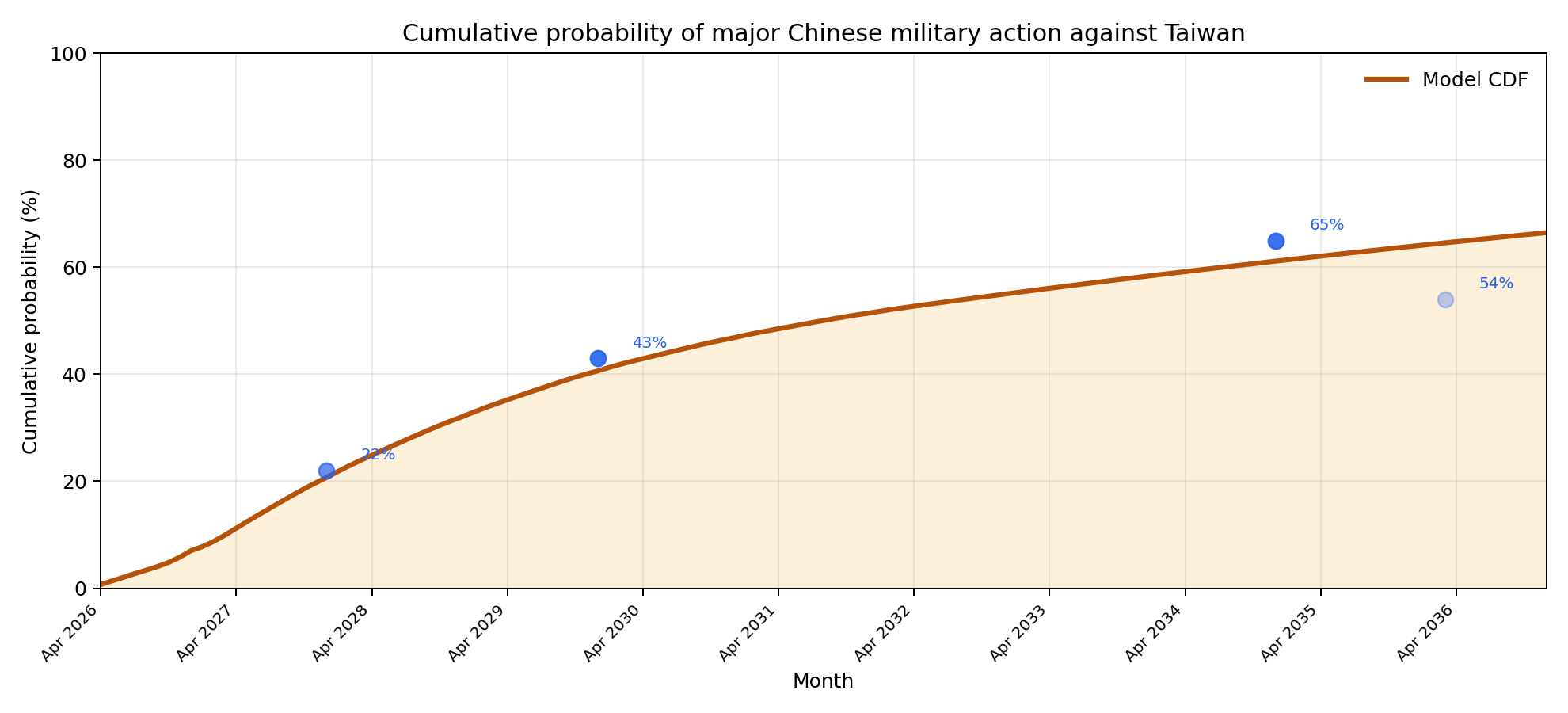
The hazard rate is time-varying: it peaks in 2027 (the PLA's stated modernisation deadline, the consensus “window of maximum danger” identified by military analysts) then gradually declines as the specific risk window passes. It remains well above the general base rate throughout the forecast horizon due to the structural nature of the cross-strait dispute. Monthly values are smoothed via linear blending at year boundaries, then converted to a cumulative CDF via the survival function.
Hazard rates and cumulative probabilities by year
| Year | Annual hazard (pooled) | Cumulative P(action by year-end) |
|---|---|---|
| 2026 | 7.9% | 7.0% |
| 2027 | 15.9% | 20.7% |
| 2028 | 14.3% | 32.1% |
| 2029 | 12.7% | 40.6% |
| 2030 | 10.3% | 46.8% |
| 2031 | 8.7% | 51.4% |
| 2032 | 7.1% | 55.0% |
| 2033 | 7.1% | 58.2% |
| 2034 | 7.1% | 61.1% |
| 2035 | 7.1% | 63.9% |
Resolution criteria
This market resolves to the earliest date at which any of the following conditions is reported by at least two of AP, Reuters, and AFP: (a) at least 1,000 People's Liberation Army military personnel have been deployed to the main island of Taiwan for the purpose of establishing PRC sovereignty; (b) the People's Republic of China has imposed a blockade that closes all major Taiwanese ports (Kaohsiung, Keelung, Taichung, and Taipei) for at least 10 consecutive days; or (c) the People's Republic of China has launched kinetic strikes (missiles, airstrikes, or naval bombardment) against military or civilian infrastructure on the main island of Taiwan. Exclusions: military exercises that do not actively intercept traffic or strike targets; cyber-only operations; actions limited to outlying islands (Kinmen, Matsu, Penghu) without action against the main island; economic sanctions or trade restrictions without physical military action.
Sources
- Metaculus Q#11480: Chinese invasion of Taiwan forecasts
- Metaculus Q#12309: China blockade of Taiwan forecasts
- Metaculus Q#5320: Chinese control of half of Taiwan by 2050
- Metaculus Q#11401: China controls Taiwan after invasion
- CSIS ChinaPower 2024: expert survey on China's approach to Taiwan
- CSIS ChinaPower 2022: earlier expert survey (64 China experts)
- Swift Centre: China-Taiwan and TSMC risks to 2027
- Pentagon 2025 Report: annual report on PRC military and security developments
- UI Sweden (2024): “Is a conflict over Taiwan drawing near?” — review of available forecasts
- EA Forum (2023): “An invasion of Taiwan is uncomfortably likely”
- Correlates of War: Militarized Interstate Disputes dataset (base rates)
Liquidity over time
i Shows the market’s available liquidity over time. Liquidity can decay continuously and may change discretely if liquidity adjustments are applied.Loading…
13 comments
Log in to comment.
Reuters reported on October 1 that U.S. officials increasingly see a Chinese invasion of Taiwan before 2028 as unlikely, despite Xi Jinping's instruction for the PLA to be ready by 2027. The report cites two current U.S. officials, one former official and one person familiar with the matter, all anonymous. Their reasons: the anti-corruption purge has hurt readiness and left two active members on the seven-seat Central Military Commission; they described last year's exercises as smaller and less threatening; and Beijing wants to see the result of Taiwan's January 2028 election. One official said a fourth straight DPP win would change that: “If that happens, I think 2028 becomes pretty sporty.” The sources discussed invasion only; the report does not assess blockade or strike options. The Pentagon declined to comment. Reuters via Internazionale: U.S. officials see invasion unlikely before 2028
China's revised National Defense Mobilization Law takes effect today, October 1. The NPC Standing Committee adopted it on August 28. Article 2 defines national defense mobilization as state action to meet threats to sovereignty, unity, territorial integrity, security and development interests by converting economic and social capacity into defense capacity, with rapid shifts between peacetime and wartime. Article 25 requires county-level and higher governments to build mobilization preparation into economic and social development plans, and military authorities to fold implementation plans into combat-readiness planning. Xinhua: full revised law text (Chinese); State Council/Xinhua: NPC Standing Committee adoption, August 28.
Taiwan’s Ministry of National Defense budget proposal sets out a six-year NT$27.59 billion (US$868.16 million) program to raise combat-ammunition stocks from 30 days to 120 days, to sustain operations during a blockade. The ministry allocated NT$7.3 billion after the Executive Yuan approved the program on September 3. A defense-planning director said the program needs to be accelerated because more frequent exercises and drills have depleted ammunition. Taipei Times, September 29
Taiwan’s defense minister Wellington Koo said on September 29 that Taipei had received no notice of a change to existing U.S. arms sales or cooperation. A separate $14 billion package remains stalled after the May Trump–Xi summit; Koo said 66 F-16V jets have reached the production stage for delivery. Associated Press, September 29
Defense Priorities’ September 10 report recommends ending U.S. mutual-defense treaties with Japan, South Korea, the Philippines and Australia and adopting a non-intervention policy for a Taiwan conflict. It proposes moving most U.S. forces from the first island chain toward Guam, Palau and other second-chain locations, with changes completed by 2035. Stars and Stripes reports about 80,000 U.S. troops are currently stationed in Japan and South Korea. This remains a think-tank proposal; the 2026 National Defense Strategy calls for a denial defense along the first island chain. Defense Priorities report · Stars and Stripes, September 23
From June 6–10, China’s Ministry of Transport said maritime authorities inspected 198 vessels east of Taiwan. The Diplomat reports that Chinese Coast Guard ships radioed all transiting commercial vessels for origin and destination details, including ships from Singapore, Benin and Liberia. The Diplomat: China is moving toward a new form of coercion at sea.
Kyodo: Beijing threatens to cancel the September 24 summit if Washington approves new Taiwan arms sales.
President promulgates KMT-backed drone bill — NT$240bn over six years in principle; annual appropriations still matter.
China deploys record number of ships around Taiwan as pressure grows — AFP. July’s 244 excludes warships.
Taiwan says ‘unpredictable’ China strengthens air and sea control nearby — Reuters.
I don't think the PLA purges mean much of anything. The PLA has a longstanding modernization program dedicated to producing an army that can take Taiwan if the political leadership decides it needs to. A few sackings/eliminations, even of elite generals, are not going to change the PLA's trajectory nor IMO do they tell us much about how the political leadership perceives PLA readiness: there are a LOT of plausible reasons to purge someone, ranging from genuine corruption and incompetence to political disloyalty to simply wanting/needing to flex party control over the army (something that has not typically been entirely guaranteed in modern China).
More significant IMO are the 2028 Taiwan elections. If the KMT wins and manages to put together enough internal coherence that it is perceived as a credible negotiating partner in Beijing, this IMO lowers the risk of invasion very substantially out to at least 2032. The CCP leadership is relatively risk averse and I think would prefer to settle the Taiwan question through political means rather than war. I think everyone in the West thinks this is impossible (especially after Hong Kong) and maybe it is, but
a) the CCP may well not agree
b) although Hong Kong is perhaps something of a failure as far as the "one China, a few different systems" model goes, Macao is still right there!
The KMT is a broad coalition with pro-US and more open-to-Beijing factions, and has historically struggled to stick to a coherent unified party platform enforced by the party leadership: everything is worked out by negotiation between factions instead. That said, the pro-Beijing faction seems to be in the ascendancy, winning the party chairmanship via Cheng Li-wun, who is currently visiting China and is expected to meet Xi (this is the first trip to China by a senior KMT figure in at least 10 years). The governing DPP is unpopular and widely perceived to be dubiously competent, and only won the last election due to vote-splitting between the KMT and TPP. I do expect the DPP to lose power in 2028, and so most of my risk is concentrated in the period after 2032: if there is no move towards a more pro-China politics on Taiwan by then, and no progress at all towards reunification talks, then invasion risk rises considerably.
Very unlikely in the next couple of years given the extensive purges in the PLA.
Also very unlikely to happen outside of March–May and September–October.
Worth watching this video of their amphibious vehicle to realise how bad rough seas will be.