SK Hynix annual revenue
Calculation of starting probabilities
The starting probabilities of this market were recalculated on 2026-09-10 using AI 2027's compute-production worldview, SK hynix's first-half results, memory-cycle history and a dated analyst forecast. All amounts are consolidated revenue in KRW trillions.
Resolution check: No yearly group is ready. The contract asks for annual revenue in FY2026–FY2029. First-half revenue is evidence for the forecast, not a full-year resolution value.
Latest evidence
SK hynix reported Q2 revenue of KRW 79.3187tn and first-half revenue of KRW 131.8950tn. These are preliminary consolidated figures in its July 2026 Form 6-K. Holding Q2 revenue constant for both remaining quarters would imply FY2026 revenue of KRW 290.5tn. This is a benchmark, not company guidance.
The Q2 release reports HBM4 mass shipments beginning in Q2 and planned expansion in the second half, supporting an acceleration scenario. Pricing and capacity cycles still create substantial uncertainty.
Reference classes and weights
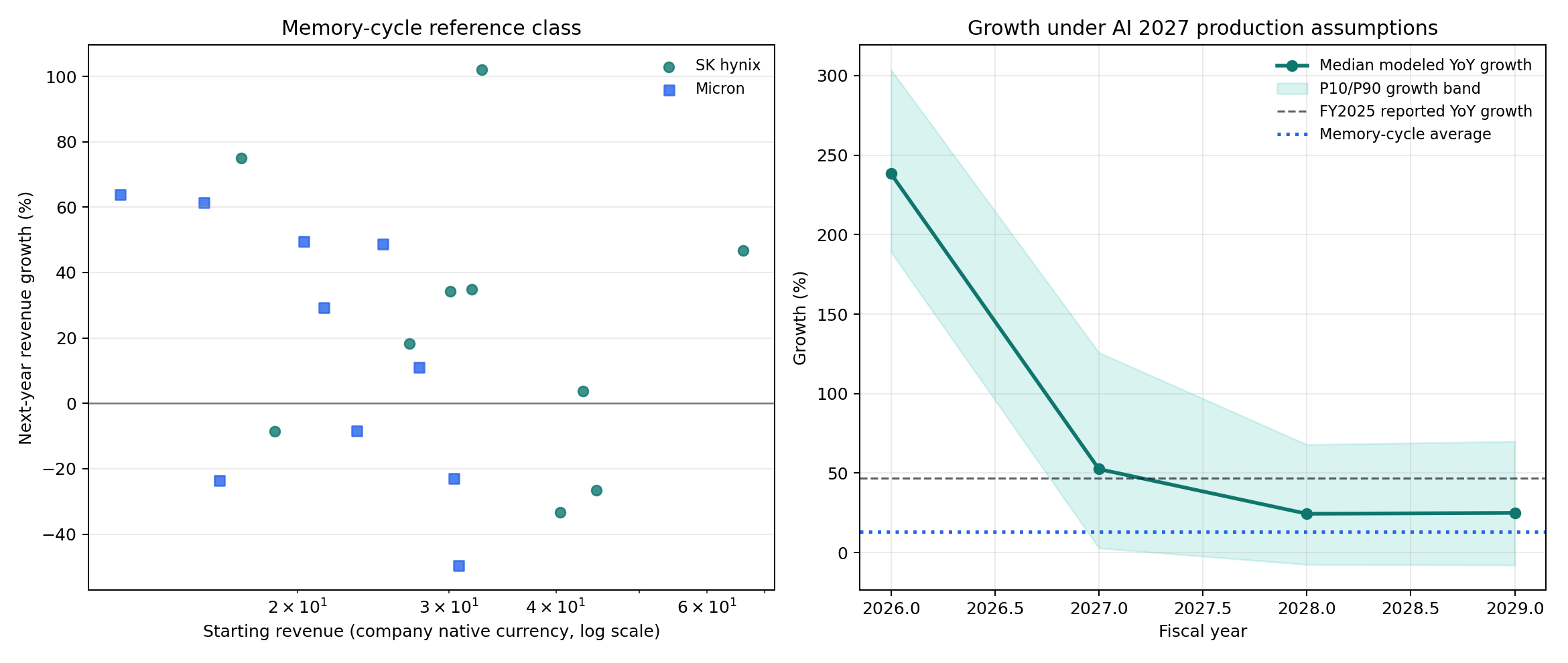
The historical sample contains 10 SK hynix and 10 Micron annual growth observations over 2015–2025. Their pooled annual log-growth standard deviation is 0.37; geometric average growth is 13%, with average boom growth 53% and bust growth -32%. These are 10 overlapping year pairs, not 20 independent industry cycles. No extra precision is claimed by dividing uncertainty by the square root of 20.
AI 2027 worldview and the revenue translation
AI 2027's April 2025 compute forecast separates physical production growth of about 1.65 times annually through 2027 from chip-performance improvements. It treats HBM and packaging as bottlenecks and anticipates chip-production growth slowing toward 1.25 times annually after 2027. We use those physical growth assumptions; we do not multiply SK hynix revenue by the growth in installed compute.
Our translation assumes an uncertain AI-linked revenue fraction averaging 75% (a Beta distribution with parameters 6 and 2), including AI-related HBM, conventional DRAM and NAND. This is an assumed revenue exposure, not a reported HBM segment share. AI-linked revenue grows with physical demand, a 3% annual price/product-mix improvement, and a 1% annual relative market-share decline. Prices and share are our assumptions, not AI 2027 predictions. Applying its post-2027 chip slowdown to memory demand is also our extension. No extra memory-per-chip multiplier is added.
Other memory's expected growth is partially pooled between an 8% prior and the historical geometric growth rate. The historical weight is 42%, giving 10.2% expected log-growth-equivalent growth. The likelihood uses 10 effective observations to allow for overlapping company cycles. The resulting latent growth rate remains uncertain.
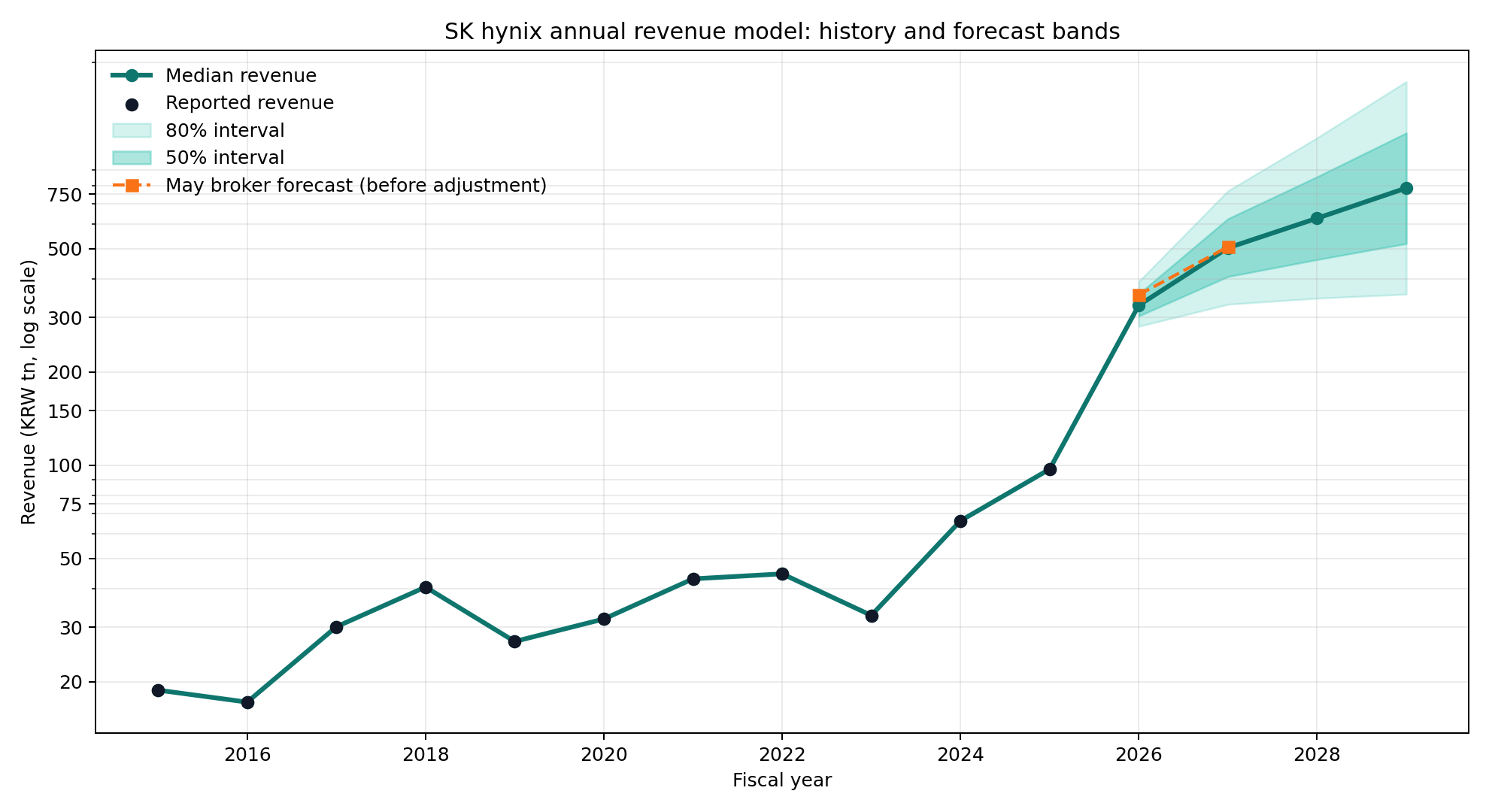
For FY2026, reported H1 is fixed. The remaining two quarters start at reported Q2 revenue and grow at the quarterly equivalent of the exposure-weighted annual rate. This contributes 59% of the log-scale pooling weight; an adjusted May broker H2 estimate contributes 41%. Mirae Asset's May 4 report projected Q2 of 82.3tn and Q3/Q4 of 101.9/118.3tn. Scaling its remaining quarters by actual Q2 divided by 82.3 gives H2 of 212.2tn. This is a mechanical adjustment, not a fresh broker forecast.
For FY2027 the AI-production path receives 80% weight and the mechanically adjusted May broker forecast receives 20%. FY2028–2029 follow the two revenue streams directly. The former revenue-size penalty and automatic fading of the HBM contribution have been removed.
Uncertainty and limitations
This is a forecast conditional on the requested AI 2027 worldview, not an independently calibrated probability that the worldview occurs. Physical growth has a persistent 0.12 log-unit uncertainty; both revenue streams share a memory-cycle shock with 0.20 log-unit scale and 0.5 annual persistence. Student-t shocks with five degrees of freedom allow downturns. Near-term structural uncertainty is 0.25 log units; the dated broker uncertainty is 0.30 for H2 and 0.50 for FY2027. Pooling adds a shared 0.15 log-unit discrepancy term rather than treating demand evidence as fully independent. Translation priors and shock scales are judgemental, not backtested. Wider physical production does not guarantee higher revenue if prices or market share fall.
The 90,000 simulated paths retain all existing thresholds. Probabilities mean P(annual revenue ≥ threshold), decrease along each ladder, and use the default 0.5%–99.5% bounds. Preliminary H1 is treated as fixed within the simulation; the probability bounds retain some allowance for revisions and model failure. No threshold is administratively resolved by that modelling assumption.
Forecast summary
| Fiscal year | Median | P10 | P90 |
|---|---|---|---|
| FY2026 | ₩329tn | ₩281tn | ₩392tn |
| FY2027 | ₩503tn | ₩331tn | ₩769tn |
| FY2028 | ₩627tn | ₩346tn | ₩1,141tn |
| FY2029 | ₩785tn | ₩357tn | ₩1,733tn |
Most influential historical examples
| Example | Revenue change | Why it matters | Context |
|---|---|---|---|
| SK hynix FY2025 | KRW 66.2tn to KRW 97.1tn, +47% | Latest completed-year anchor; HBM revenue more than doubled. | FY2025 results |
| SK hynix 1Q26 | KRW 52.6tn quarterly revenue, +198% year over year | Reported first-quarter revenue anchor. | 1Q26 results |
| SK hynix FY2024 | KRW 32.8tn to KRW 66.2tn, +102% | Shows how quickly memory revenue can rebound from a trough. | FY2024 results |
| SK hynix FY2023 | KRW 44.6tn to KRW 32.8tn, -27% | Downturn example that prevents straight-line AI extrapolation. | FY2024 comparative table |
| Micron FY2025 | $25.1bn to $37.4bn, +49% | Memory peer exposed to the same AI-led upcycle. | Micron FY2025 results |
| Micron FY2023 | $30.8bn to $15.5bn, -49% | Large peer-cycle bust used to keep downside tails wide. | Micron comparative figures |
Reproducibility
Liquidity over time
i Shows the market’s available liquidity over time. Liquidity can decay continuously and may change discretely if liquidity adjustments are applied.Loading…
0 comments
Log in to comment.