External deployment before internal deployment at a frontier AI lab – 2030
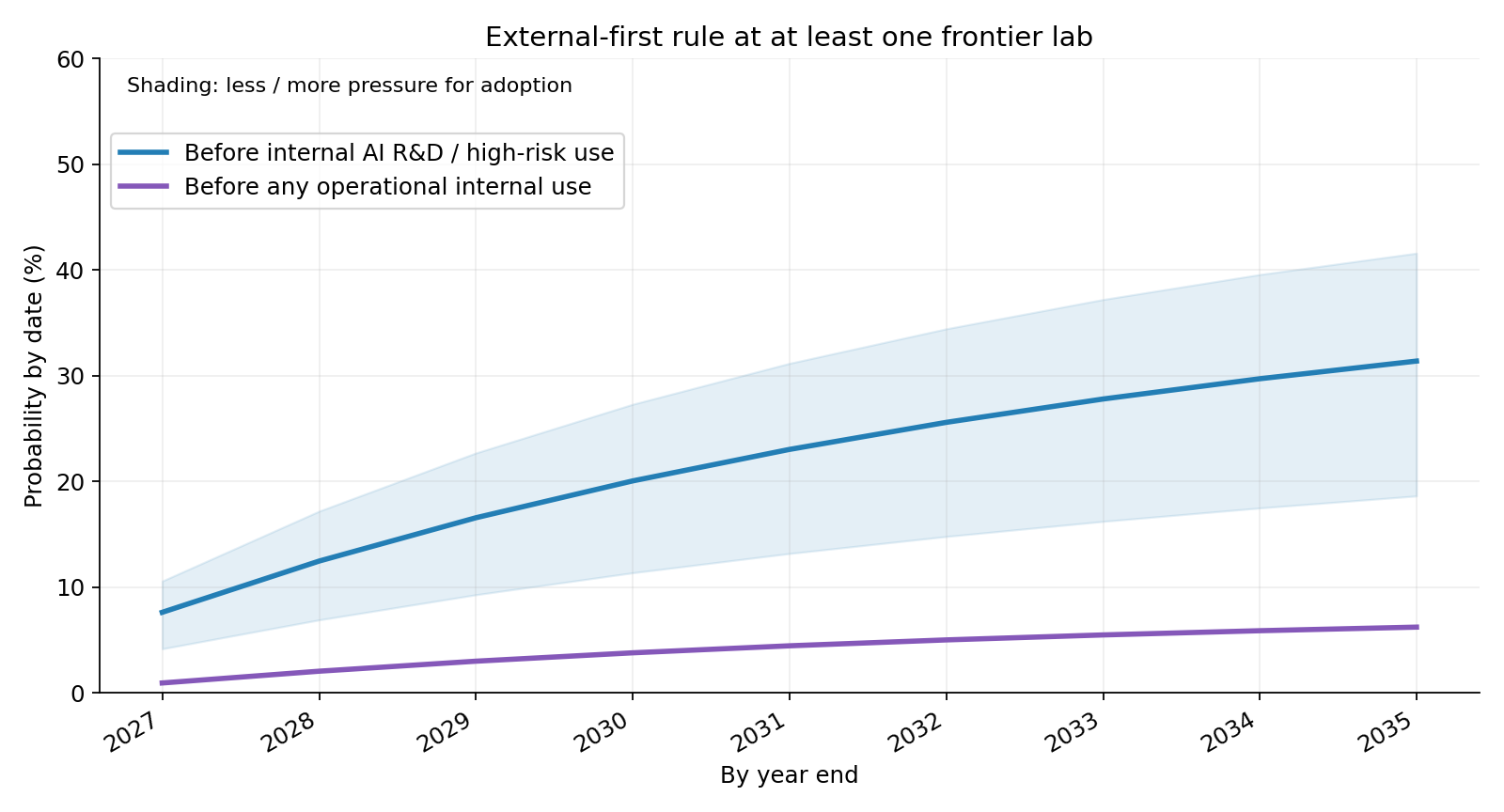
By each date, will at least one major frontier AI laboratory have adopted and actually followed an external-first deployment rule?
External before any internal deployment: a new frontier model is deployed to unaffiliated users before its first operational internal use.
External before internal AI R&D / high-risk deployment: a new frontier model is deployed to unaffiliated users before internal deployment for advancing AI capabilities or other uses posing comparably serious loss-of-control or catastrophic-misuse risks. Lower-risk internal use is permitted in this category.
External deployment means real use by outside users, including a controlled customer rollout. Outside safety evaluation, red-teaming, an announcement or access confined to company-controlled affiliates does not suffice. Internal deployment means operational use for the laboratory’s work. Ordinary training, alignment work and bounded development or safety testing are not themselves deployment; using a model operationally to develop more capable AI is.
There must be clear public evidence of a deliberate rule or established practice, followed for at least one rollout of one of the laboratory’s leading general-purpose models. An incidental sequence, an obsolete-model release or a pledge without implementation does not count. No minimum external-use period or particular legal form is required. Subsequent internal deployment need not already have occurred if the rule is in force, external deployment has occurred and the relevant internal use has been withheld.
A major frontier lab means a developer widely recognized at the time as being among the leaders in general-purpose AI capabilities; examples today include OpenAI, Anthropic and Google DeepMind. Future entrants and successors can qualify. At least one lab is sufficient; industry-wide adoption is not required. Credible company or evaluator documentation, findings or reliable reporting can establish the event. Evidence must be public by the date’s end. Later abandonment does not reverse an earlier YES. The full restriction also satisfies the AI R&D / high-risk category.
Bars include events up to their close, 23:59:59 UTC: “By end of Dec 2027” includes everything up to 31 Dec 2027, 23:59:59 UTC.
The starting probabilities of this market were calculated by considering what would lead a frontier lab to adopt an external-first rule, and how quickly it could apply that rule to a model release.
Labs gain useful research and engineering work from early internal access. OpenAI describes using early versions of GPT-5.3-Codex in the model’s own development. Giving up that advantage would be a substantial change in practice.
Pressure for a change could come from internal incidents, independent evaluators, regulation or a lab choosing to demonstrate a stricter safety approach. IAPS’s work on internal-use risk reporting sets out why internal deployment deserves separate scrutiny. Anthropic’s pacing proposal also discusses restrictions on internal use of AI to improve AI.
The forecast weighs three possible environments. Each row applies to adoption by at least one frontier lab:
| Environment | Weight | Chance a lab eventually adopts the AI R&D/high-risk rule | Yearly chance of putting it into practice, if adoption will happen |
|---|---|---|---|
| Strong pressure and a workable external-first proposal | 25% | 80% | 20% |
| Sustained concern, with competing approaches to internal safety | 50% | 50% | 8% |
| Commercial and research incentives continue to dominate | 25% | 10% | 2% |
These are explicit assumptions about a new policy. They put the most weight on a mixed outcome: internal-use safeguards improve, while the external-first rule attracts limited support. The yearly chances combine the time needed to agree a rule and apply it to a suitable release.
A ban on all operational internal use would also cover ordinary employee work. It would have a broader cost and a weaker connection to the highest risks. In the three environments above, the model gives a 25%, 15% and 5% chance respectively that adoption extends to this stronger rule. It allows roughly another six months to implement it. Whenever the stronger rule qualifies, the AI R&D/high-risk category qualifies too.
The sensitivity curves put more or less weight on strong pressure. They show how much depends on the policy environment over the coming decade.
Calculation code · Sources and their use · Model assumptions and results
Liquidity over time
i Shows the market’s available liquidity over time. Liquidity can decay continuously and may change discretely if liquidity adjustments are applied.Loading…
0 comments
Log in to comment.